
Everyday life · Greener shared spaces
Plants for your home or neighborhood: where to start in Asunción
Sources checked 3 November 2026
A few plants for a patio, a greener neighborhood square and a tree-planting project need different kinds of help. Asunción has municipal growing and environmental-education programs, but their plants are not one shared stock that anyone can collect at any time. Start with the place you want to improve and the people who will look after it. That makes it easier to ask the right office for a realistic next step.
Choose the route that fits your project
- A small home or community growing project: ask about the Centro de Conservación y Educación Ambiental, known as CCEAM, inside the Jardín Botánico.
- Plants for a neighborhood public space: ask your neighborhood association about a request to the municipal Departamento de Áreas Verdes.
- Taking on improvements or maintenance in a plaza or park: read the separate Protectores de Espacios Verdes program before making commitments.
These are starting points for enquiries, not confirmed appointments or promises of plants. Keep the original Spanish names in your message so the municipal team can route it correctly.
CCEAM: an option for small growing projects
In its 9 June 2026 CCEAM update, the municipality described free seedling distribution to interested residents and organizations, subject to availability. It also described visits for community and educational groups. The notice does not publish a current collection timetable, reservation system or guaranteed list of plants.
Before travelling, ask whether distribution is taking place, what is available and where within the large Botánico grounds you should go. If you want a group visit, say how many people would attend and whether you are seeking a guided activity or simply information about growing plants. A normal garden visit does not automatically include a scheduled CCEAM activity.
Our Jardín Botánico visitor guide explains the wider site. Use it for orientation, then confirm your specific appointment separately. If a plant is described as medicinal, that label is not advice to ingest it or use it to treat an illness.
Parque Caballero's nursery: a neighborhood route
The municipality's 3 August 2026 nursery update describes formal requests from neighborhood organizations, followed by assessment and a site inspection by Áreas Verdes. It distinguishes this nursery's ornamental and forestry work from fruit-tree production at the Botánico.
Ask your comisión vecinal who can coordinate the request. Agree on one contact person and one description of the proposed space. Sending several different requests for the same corner can make the intended project harder to understand.
That August notice anticipated nursery works continuing into November or December. It is not evidence that construction has finished. Ask where requests are currently received and whether collection or technical visits are affected before arranging transport or a planting day.
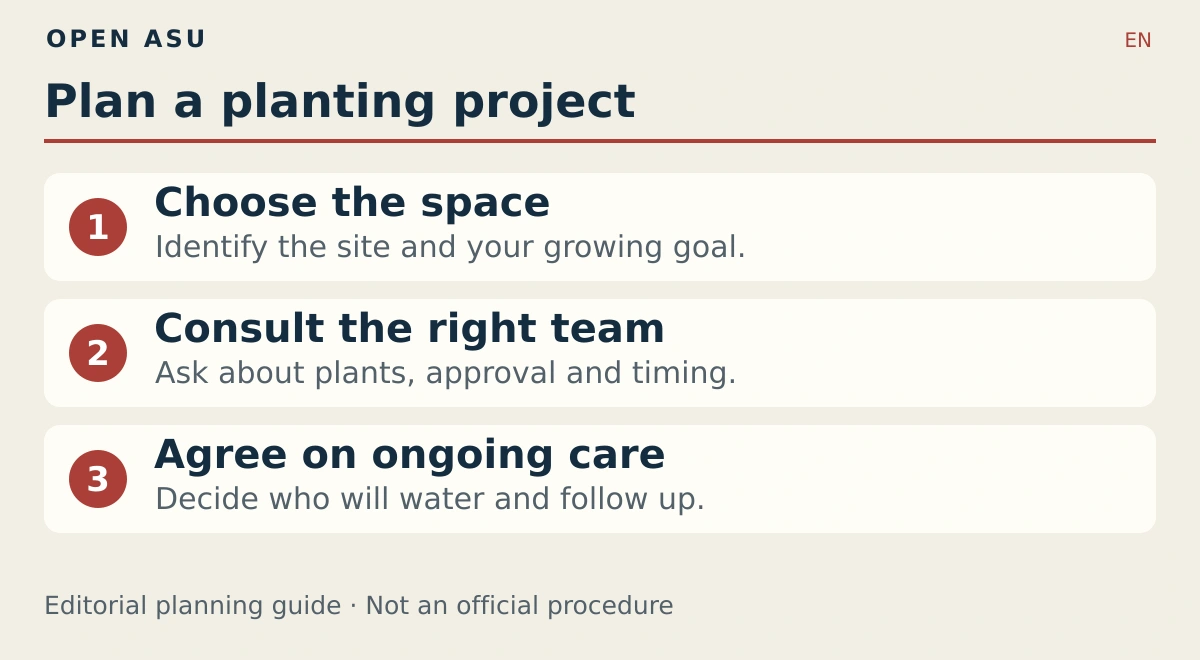
Planning steps in text
- Choose the space: Identify the site and your growing goal.
- Consult the right team: Ask about plants, approval and timing.
- Agree on ongoing care: Decide who will water and follow up.
A plaza partnership involves more than collecting seedlings
The official Protectores de Espacios Verdes page links to a proposal form and requirements. Its requirements sheet describes cooperation agreements for public-space investment or maintenance, including project documentation. It lists enquiries at WhatsApp 0971 188-888 and protector@asuncion.gov.py. Confirm the current requirements and any costs with the program before submitting personal documents or accepting obligations.
A 21 May launch announcement promoted a simplified digital route. Treat that as the program's announced process, not a guaranteed approval time. Read the requirements linked on the live page as well as the announcement; a short online form is only one part of a project proposal.
Prepare a useful first enquiry
The following is a planning checklist, not an official application form:
- Identify the space with a street, nearby intersection and a clear photograph.
- Explain whether you mean a private patio, shared garden or public plaza.
- Describe the goal: shade, a small growing area or replacing neglected planting.
- Say who can water and care for the plants after the first day.
- Ask which species, location and planting date the technical team recommends.
- Confirm what approval is needed before working in a public space.
Avoid ordering plants first and finding a site later. A narrow pavement, overhead cables, drainage, access and the mature size of a tree all deserve attention in the planning conversation. Bring those questions to the technical team rather than treating a decorative sketch as a planting plan.
Make the project manageable
For a first shared project, a small area with an agreed watering rota is easier to look after than several scattered sites. Decide who will keep the request reference and share updates with the group. Confirm the plants and arrangements again before asking people to carry tools or give up a morning.
If plants are unavailable, keep the enquiry open without promising a new date. You can still agree on the space and care responsibilities. The useful outcome is a project the group can sustain after the planting photo, with the municipality's role and your own responsibilities clear.
For everyday local tips, find the Open Asu community on WhatsApp.